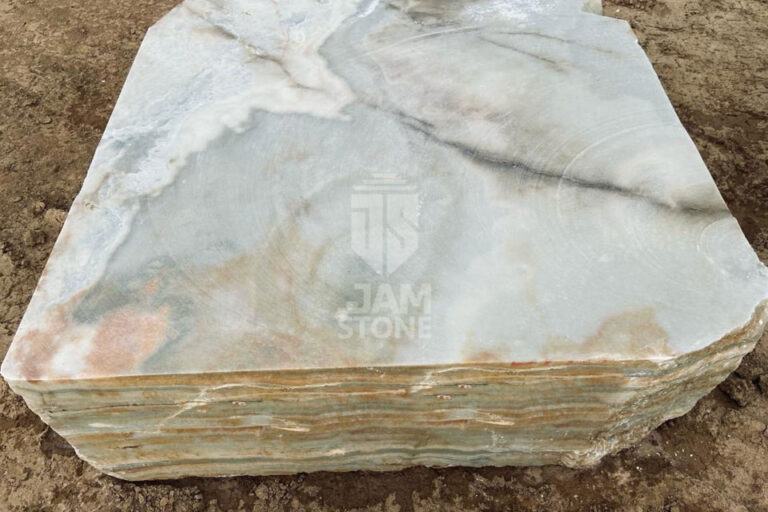
Light Blue Onyx brings the calm look of clear skies and water into interior spaces. In luxury homes, hotels, and spas, this translucent stone glows softly when it is backlit, creating a gentle, relaxing mood without harsh lighting. Its pale blue base, white clouds, and golden lines give every slab a unique pattern, almost like a moving cloud or a frozen wave. Designers choose it for feature walls, bar fronts, and bathroom vanities where both colour and light are important. Let’s explore how Light Blue Onyx can add quiet elegance to modern projects.
When quality matters, choosing the right supplier can make all the difference. JAM Stone Co. is a trusted supplier of Light Blue Onyx from Iran, working closely with skilled quarry owners and modern factories. The team selects blocks for stable blue tone and clean veining, then uses resin treatment, mesh backing, and careful polishing to prepare strong, smooth slabs. Each batch is checked for thickness, flatness, and gloss so that pieces fit together well on-site. With organised packing and export support, JAM Stone Co. helps projects receive Light Blue Onyx in a safe, ready-to-install form.
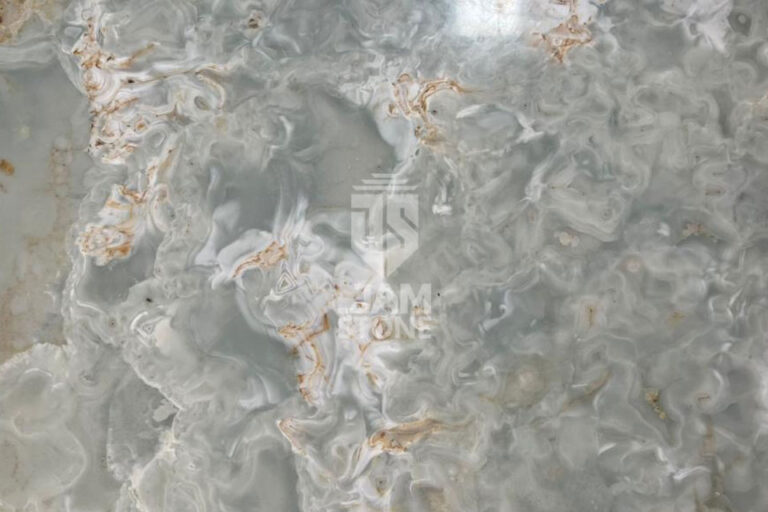
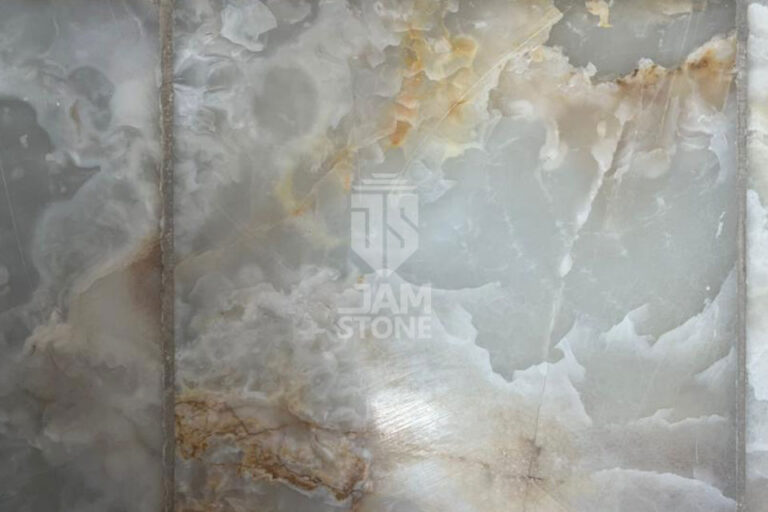
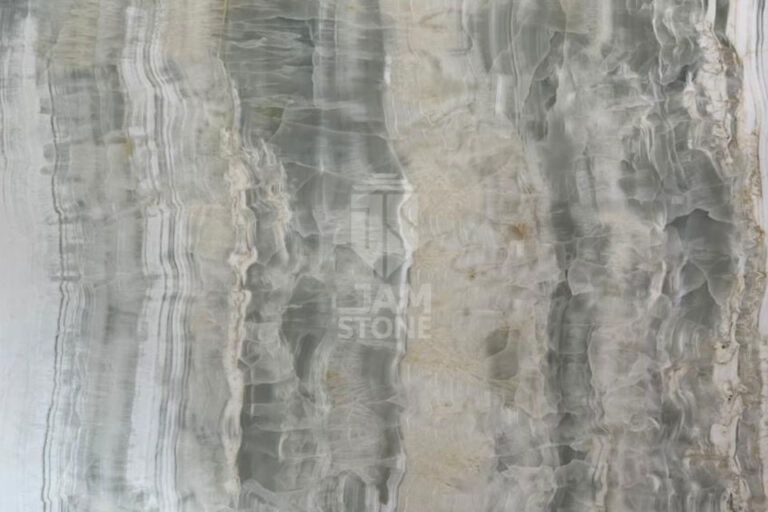
Light Blue Onyx is a translucent, banded decorative stone that belongs to the calcite onyx family. It is mainly quarried in Iran and is sometimes traded under names like Persian Blue Onyx, Golden Blue Onyx, or Aqua Blue Onyx, depending on the exact colour mix. The stone shows a pale to medium blue background with white clouds and golden lines that move across the surface. It is cut into slabs, tiles, and smaller pieces for indoor projects where designers want both colour and light to play across walls, counters, and other features.
Light Blue Onyx has physical and structural properties similar to other calcite-rich architectural onyx types. It has a bulk density in the range of about 2.5 to 2.7 grams per cubic centimetre, which means it feels solid and heavy in hand. Its open porosity is usually low to moderate and typically around 1 percent, and water absorption is often below 1 percent by weight. Compressive strength commonly falls between seventy and one hundred twenty megapascals, with flexural strength in the range of about eight to fifteen megapascals, so careful support design is important.
Light Blue Onyx is mainly composed of calcite, the calcium carbonate mineral that forms in bands and layers. Small amounts of aragonite and trace elements are also present. The blue tones are linked to elements such as copper, manganese, or carbon, while cream and white areas are purer calcite. Natural porosity is usually low to moderate.
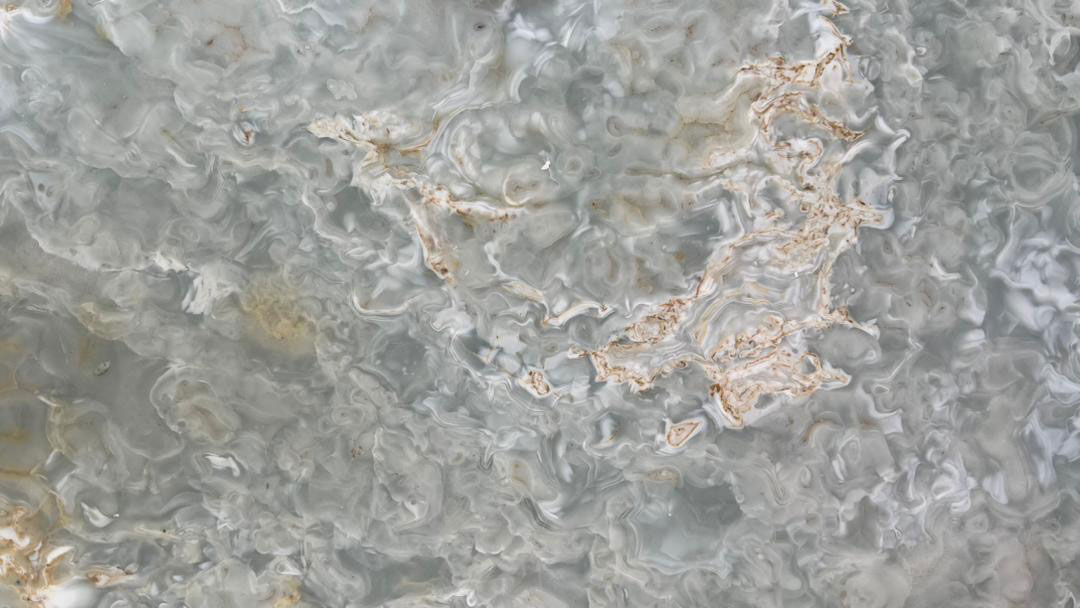
The base colour of Light Blue Onyx ranges from very pale sky blue to deeper blue-grey or aqua. White clouds, cream bands, and golden streaks move across the surface in waves or swirls, giving each slab a distinct look. Vein density is medium to high, which suits bookmatched panels and large, continuous feature walls.
For Light Blue Onyx, surface density is similar to other dense onyx stones, generally about 2.6 to 2.7 grams per cubic centimetre. Open porosity is typically around half to one and a half percent, often reduced when resin fills microvoids and fine seams. Water absorption is commonly below 1 percent by weight; in service, proper sealing further reduces surface water uptake and staining.
Light Blue Onyx has a Mohs hardness of about three, so it is softer than granite and can scratch under heavy use. Compressive strength generally lies between seventy and one hundred twenty megapascals, with flexural strength in the range of eight to fifteen megapascals. These values are normal for calcite onyx and call for careful support.
Like many banded onyx stones, Light Blue Onyx can show natural features such as tight seams, stylolites, cloudy pockets, and small voids. These reflect the stone’s formation history and are not always defects. During processing, resin fills pinholes and hairline fissures, while larger cracks are cut out. Quality control limits visible open seams.
Light Blue Onyx combines a cool, translucent colour palette with the performance profile of a calcite-based decorative stone. When it is polished, the surface becomes glassy and reflects light, which strengthens the blue tones and reveals fine details inside the bands. Honed or brushed finishes soften reflections and give a quieter, more relaxed look. Because the stone is rich in calcium carbonate, it is sensitive to acids and needs regular sealing and gentle, pH-neutral cleaning to stay in good condition over time.
The main visual appeal of Light Blue Onyx comes from its high translucency and calm, blue-toned colour field. When slabs are backlit, the internal bands and clouds glow and show extra depth. A polished finish gives a strong gloss and mirror-like effect. Honed and brushed finishes lower glare but keep the patterns clear and readable.
To the touch, polished Light Blue Onyx feels smooth, cool, and almost glass-like because the calcite crystals are finely ground and the surface is sealed. Resin treatment also helps reduce micro-pitting so the hand moves easily across the face. Honed finishes feel softer and silkier, while brushed finishes add gentle relief for a light grip.
In indoor settings, Light Blue Onyx weathers well when correctly installed, sealed, and maintained. Strong, constant sunlight can slowly affect resins and may warm the stone, so fully exposed exterior cladding is usually not advised. The material is also sensitive to thermal shock and is not ideal for freeze-thaw cycles or heavy-duty exterior paving.
Light Blue Onyx is mainly made of calcium carbonate, so it reacts with acids such as lemon juice, vinegar, or wine. Even weak acids can cause etching, seen as dull spots or rings on the surface. To reduce this risk, the stone should be protected with a penetrating sealer and cleaned only with pH-neutral products and soft cloths.
Light Blue Onyx is supplied in the standard range of formats used for architectural onyx, including blocks, slabs, tiles, cut-to-size elements, and mosaics. Slabs are produced in medium to large sizes that suit wall panels, kitchen islands (with care), and reception desks. Tiles and smaller pieces suit floors in low-traffic areas, bathroom walls, and decorative panels. Because the stone is relatively fragile, very large exterior pavers are not usual or recommended. Smaller, carefully supported units give better long-term performance indoors.
Light Blue Onyx slabs are usually cut from blocks into lengths of around 240 to 280 centimetres and widths of about 120 to 170 centimetres. Standard thicknesses are 15, 20, or 30 millimetres, with 20 millimetres most common. Most slabs receive resin treatment and fibreglass mesh backing to improve stability during handling.
Tiles in Light Blue Onyx are produced in familiar marble sizes such as 30 × 30, 30 × 60, or 60 × 60 centimetres, often at 10 to 20 millimetres thick. Thicker tiles are preferred for flooring, while thinner ones work well for wall cladding. A flat substrate and white adhesive help prevent shadows from showing through the translucent stone.
Cut-to-size Light Blue Onyx pieces are used for custom stair treads and risers, reception counters, bathroom vanities, and wall panels. Dimensions follow project drawings and can match vein direction or bookmatched layouts. For long spans or areas with openings, such as around sinks, designers often add extra support or laminated build-ups to protect the stone.
Mosaics made from Light Blue Onyx are normally supplied as mesh-mounted sheets, often about 30 × 30 centimetres, using small chips around 8 to 10 millimetres thick. They work well as feature strips, shower niches, or accent walls where fine pattern and light play are desired. Pre-sealing the pieces before grouting reduces grout haze and staining.
Because it is a softer, translucent calcite onyx, Light Blue Onyx is not commonly chosen for heavy-duty pavers, especially outdoors. In covered interior courtyards or low-traffic zones, thicker pieces of at least 30 millimetres may sometimes be used on a rigid bed. Even then, regular sealing, gentle cleaning, and realistic expectations about wear are needed.
Skirting and baseboards in Light Blue Onyx are usually cut to heights of around 8 to 12 centimetres and thicknesses of 15 to 20 millimetres, with lengths coordinated with wall panels. Matching the vein direction with adjacent cladding helps create a continuous look. Factory sealing of faces and edges gives extra protection during installation and later cleaning.
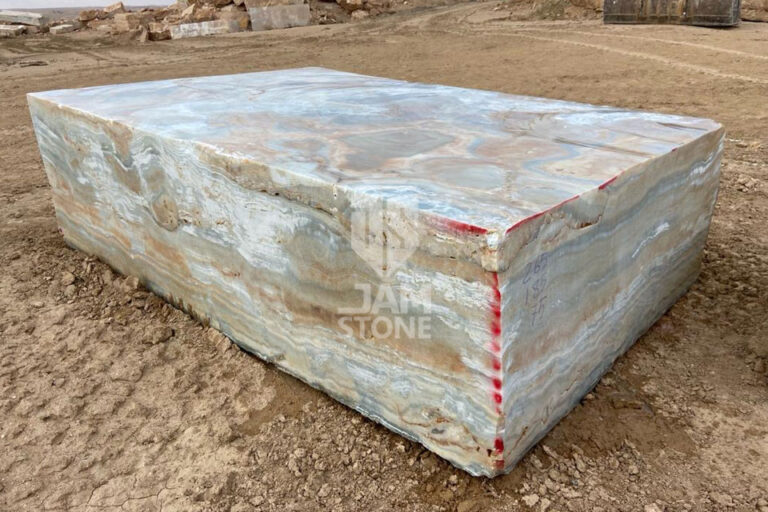
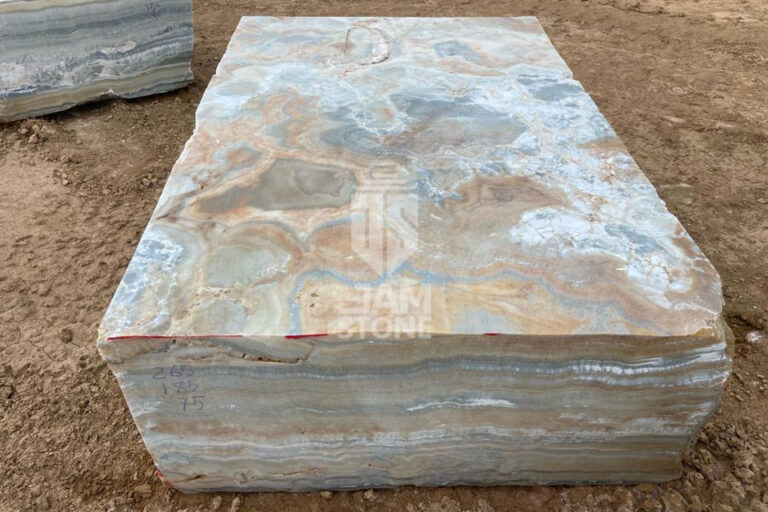
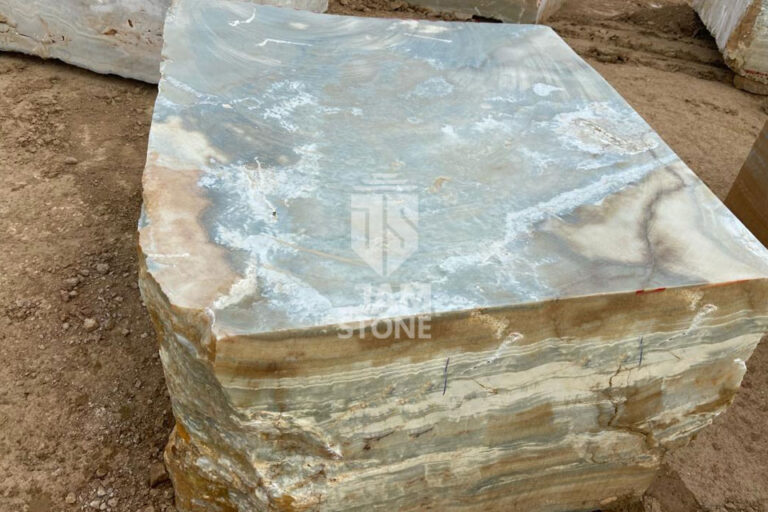
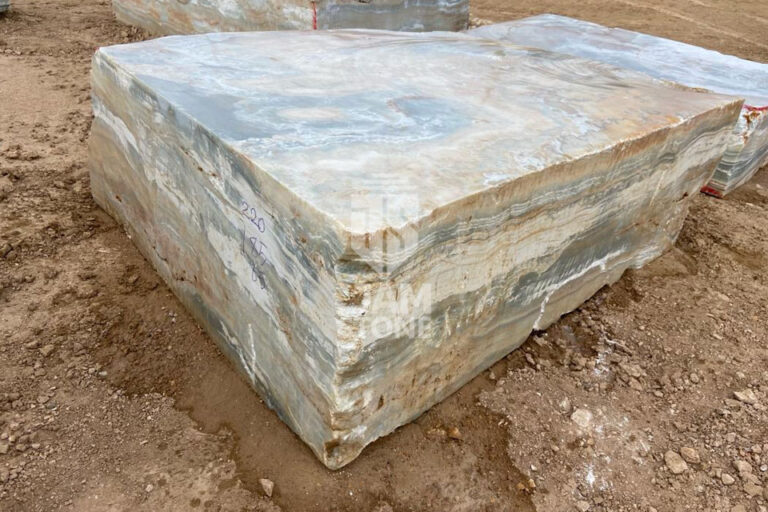
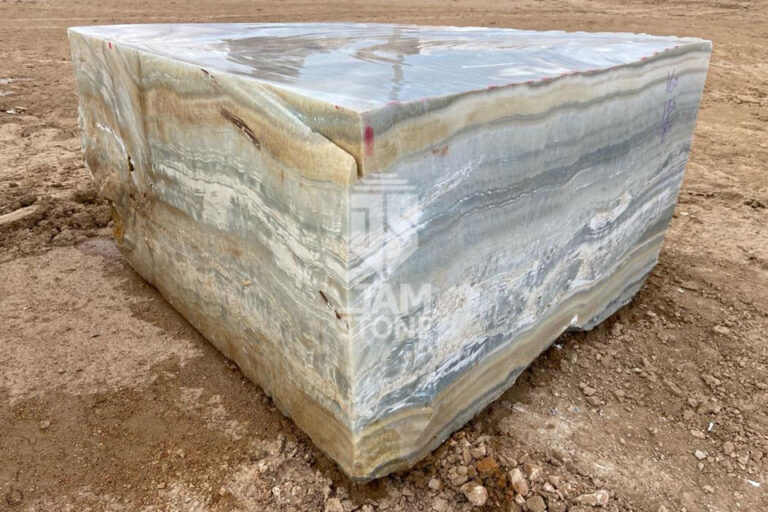
Light Blue Onyx blocks are extracted from selected benches in Iranian quarries and then trimmed for optimum yield. Block sizes can range from roughly one and a half to several tonnes, depending on natural jointing and access in the quarry. Larger, cleaner blocks with stable blue colour and few structural seams are reserved for high-end projects.
Typical applications of Light Blue Onyx focus on interior spaces where light and colour can really show. Designers use it for backlit feature walls in hotel lobbies, bars, and reception areas, as well as for counters and islands that are protected from heavy impact. It also works well for bathroom vanities, wall cladding, shower surrounds, fireplace faces, and stair cladding in low-traffic areas. Polished slabs are popular for statement pieces, while honed or brushed finishes suit bright rooms where lower glare is helpful and cleaning is still easy.
The price of Light Blue Onyx sits in the high, luxury range because this stone is rare and demand is strong. Cost depends on many factors along the supply chain, from how clean and blue the blocks are to how they are processed, finished, and shipped. Larger, more regular blocks that allow bookmatched slabs usually cost more. The final figure also changes with project size, cutting plans, and destination. For this reason, buyers should always request a project-specific quote from their chosen supplier.
The grade of Light Blue Onyx is one of the strongest drivers of price. Slabs with clear, even blue colour, clean white clouds, and fine golden lines are treated as premium material. Lots with more mixed tones, cloudy patches, or busy dark areas usually fall into lower grades and are priced below the top selection.
Block size and slab yield strongly affect cost. Large, sound blocks with few structural seams let factories cut big slabs and long runs for bookmatched walls, which raises value. Smaller blocks, or those with many internal joints or unusable parts, give fewer high-quality slabs per tonne and are therefore less expensive per square metre.
Processing quality also plays a key role in price. Careful sawing, full resin impregnation, and proper mesh backing all add cost but give more stable panels. Accurate calibration and a fine, even polish require time and skilled work. Strict quality checks reduce hidden defects and waste on-site, which many projects accept as part of a higher overall value.
Finish type has a direct impact on the factory cost of Light Blue Onyx. High-gloss polish, especially on large, clean slabs, requires more grinding, finer abrasives, and close inspection. Honed surfaces may be slightly less costly, while special textures such as brushing or other custom treatments add extra steps. Each option changes both appearance and price.
Thickness and overall piece size change how much stone and work are needed. Standard 20 millimetre slabs usually cost less per square metre than 30 millimetre slabs, which use more material and need stronger handling. Very large or complex cut-to-size elements, such as long counters with mitred edges, require more careful cutting and finishing and are priced higher.
Transportation and availability complete the price picture. Light Blue Onyx comes mainly from selected quarries in Iran, so distance to the project, shipping method, and current freight rates all matter. Secure packing, insurance, and handling at ports add further cost. When quarry output is low or demand is high, prices tend to rise even for similar material grades.
Light Blue Onyx starts its journey in Iranian quarries, where geologists and quarry teams search for benches with stable blue colour and good banding. After marking natural joints, workers cut the stone into rough blocks using wire saws and controlled drilling. The goal is to remove blocks with as few cracks and weak zones as possible. These blocks are then trimmed to remove damaged parts and loaded for transport to processing plants. Careful handling at this stage is important, because the stone is both precious and more fragile than many other hard stones.
In the factory, Light Blue Onyx blocks are sawn into slabs with gangsaws or circular saws. The slabs are dried and often treated with resin, sometimes under vacuum, to fill small pores and hairline seams. A fibreglass mesh is usually fixed to the back of the slab to increase stability. After curing, the stone is calibrated to an even thickness and then ground and polished or honed. Each piece is checked for colour, pattern, thickness, and flatness before packing. Finally, slabs and tiles are wrapped, crated, labelled, and loaded into containers for delivery.
Good performance of Light Blue Onyx begins with correct installation. For fixing tiles and slabs, white polymer-modified thinset or suitable stone epoxy is recommended, especially where the stone is backlit or very translucent. Substrates must be flat, rigid, and clean. Grout joints are usually kept narrow, around 1.5 to 3 millimetres, with movement joints at edges and changes in direction. A penetrating sealer should be applied before grouting to reduce staining and then again after final cleaning. Regular resealing, often every 6 to 12 months in busy areas, helps protect the surface.
Daily care should focus on gentle cleaning and protection from damage. Spills of acidic liquids like lemon juice, vinegar, and wine should be wiped up quickly to reduce etching. Only pH-neutral cleaners and soft cloths or mops should be used; abrasive pads and harsh chemicals can scratch or dull the stone. On counters, coasters, chopping boards, and trivets help avoid marks from glasses, knives, and hot pans. On floors, soft mats at entrances catch grit that can cause scratches. Avoid dragging heavy furniture across polished surfaces to keep Light Blue Onyx looking clear and smooth.
JAM Stone Co. manages Light Blue Onyx from the quarry face to the finished slab through integrated operations. The company works with long-term, reputable mine owners in key stone regions of Iran to secure blocks with stable blue colour and clean veining. In modern plants, these blocks are sawn, resined, and reinforced with mesh, then processed using waterjet cutting and precision polishing lines. In-house quality labs monitor grading, thickness, flatness, and gloss at several checkpoints. This controlled process helps JAM Stone Co. act as a reliable exporter of Light Blue Onyx for complex, design-driven projects.
JAM Stone Co. supports buyers by combining technical quality with flexible service. Each batch of Light Blue Onyx passes several inspections, including visual grading, checks on surface flatness, and control of edge integrity before packing. The company follows recognised international standards and maintains documentation that helps with project approvals in regions such as the GCC, Europe, and East Asia. Mixed loads and different minimum order quantities are possible, so both boutique jobs and large projects can be supplied. Client-specific cutting, bookmatching, and backlighting layouts are also available from this experienced provider of Light Blue Onyx.
For Light Blue Onyx, JAM Stone Co. works with strategically chosen quarries in Iran where blue onyx benches show steady colour and repeating banding. These reserves provide blocks in a range of sizes, from smaller pieces for tiles to larger, cleaner blocks suited to statement slabs and matched panels. Close cooperation with quarry teams gives better control over which benches are opened and how blocks are extracted, helping to stabilise supply over time. Attention to responsible extraction, reduced waste, and careful water use supports more eco-conscious production while still delivering premium-quality raw material for processing.
Packing is planned to keep Light Blue Onyx safe from the factory to the final site. Slabs are stacked in strong wooden bundles or on A-frames, with foam sheets and plastic film between polished faces, plus corner protectors to guard edges. Tiles, cut-to-size pieces, and mosaics are loaded into wooden crates with internal spacers to prevent movement. Moisture-resistant wrapping and secure strapping help protect the stone during sea or road transport. Each crate carries clear labels showing material name, thickness, finish, batch or lot number, and piece list, making checking and installation easier for the site team.
is more than just a decorative material; it is a masterpiece of nature that adds unparalleled elegance to any space.


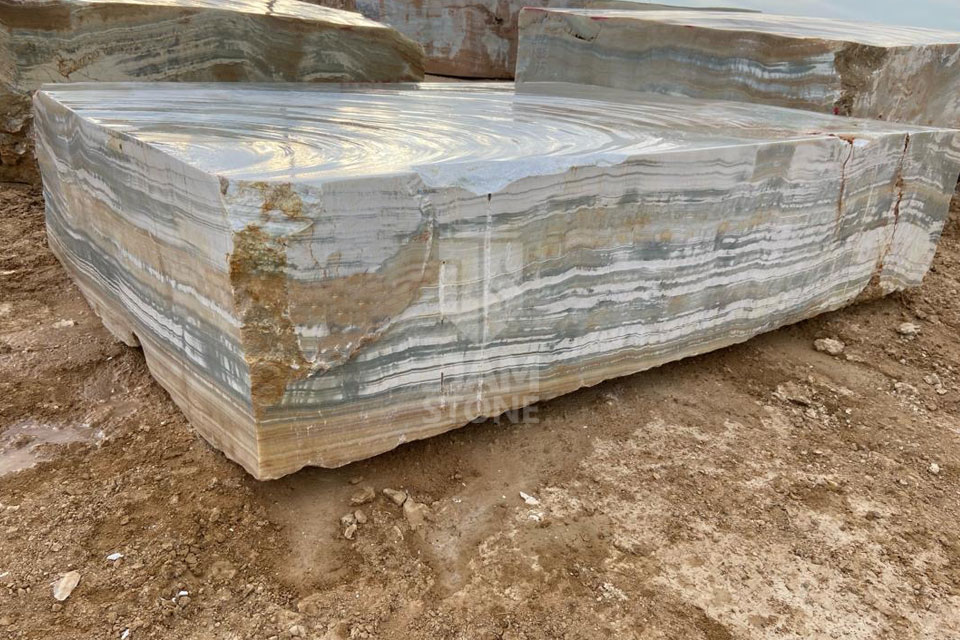
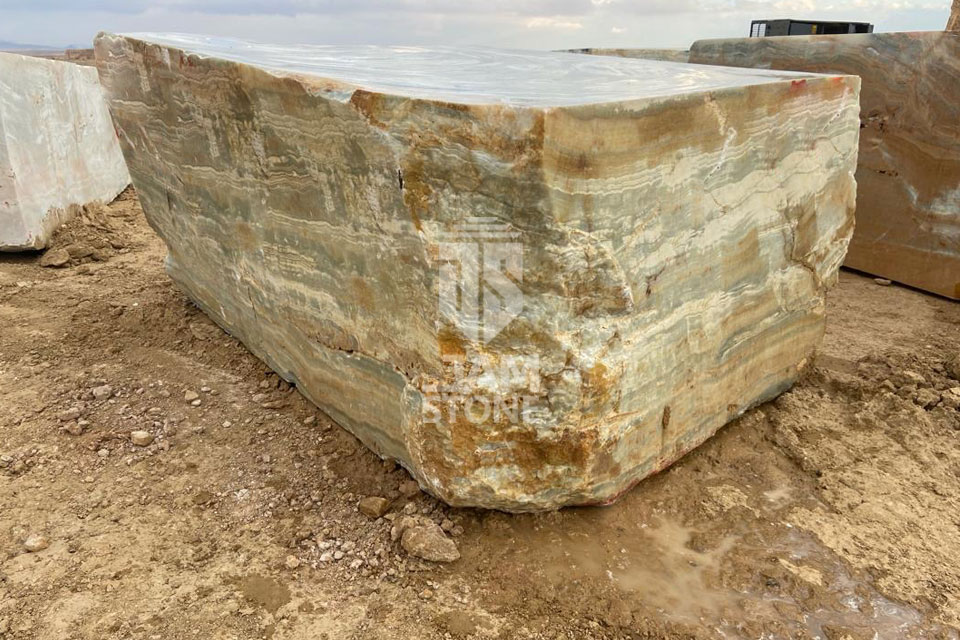
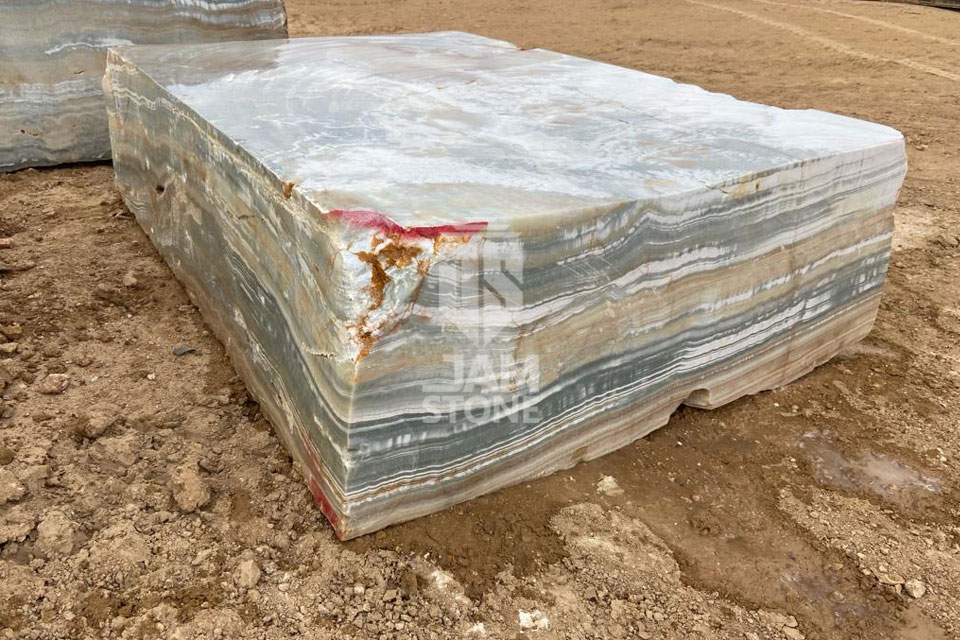
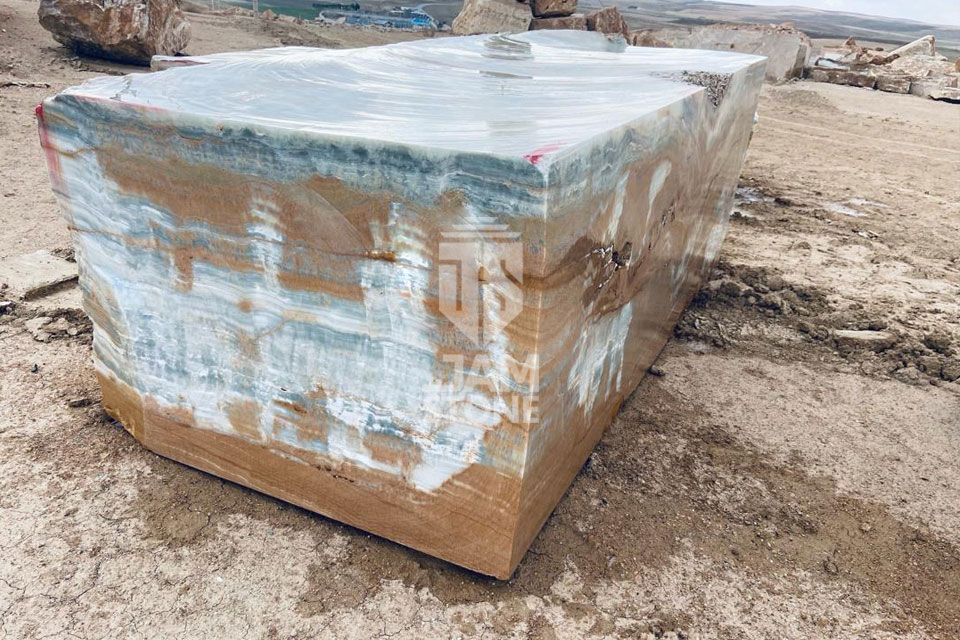

Light Blue Onyx enjoys significant demand in international markets, revered by architects and designers across the globe. It is particularly popular in regions famed for luxury design, such as the United States, Europe, and the Middle East. Thanks to its aesthetic appeal, durability, and versatility, this stone continues to gain prominence in global architecture and interior design projects.